

Hydrogen is the fuel of the future at the Port of KlaipĖda
The increasingly stringent environmental requirements of international organisations and national authorities, the increasingly promoted transition to climate and nature neutrality and other global trends commit the Port of Klaipėda to take into account the state of the environment and to continuously strive to improve it in the organisation of its future activities, in the development of its operations and in the planning of port projects. To meet this goal, it has been decided to develop a green hydrogen production and supply project.
On 5 June 2026, Klaipėda Port has officially opened Lithuania’s first green hydrogen production and refuelling facility, marking a significant milestone in the country’s transition to clean energy.
The project serves as the starting point for a new, more sustainable transport ecosystem. The Port of Klaipėda’s green hydrogen production and supply project is the first of its kind among Baltic seaports.
Read more about the opening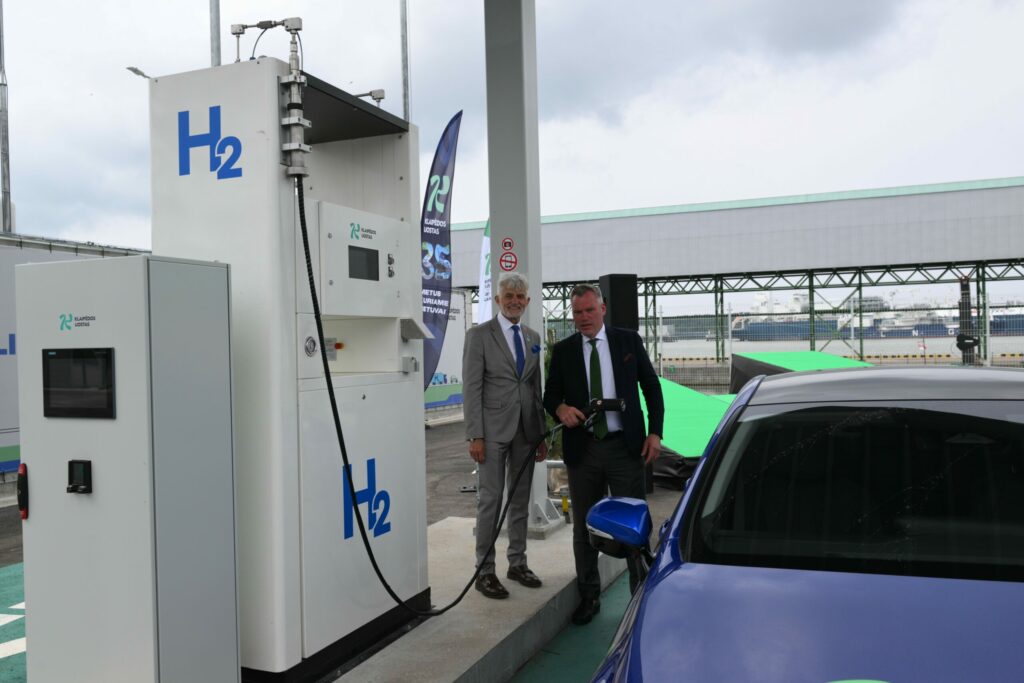
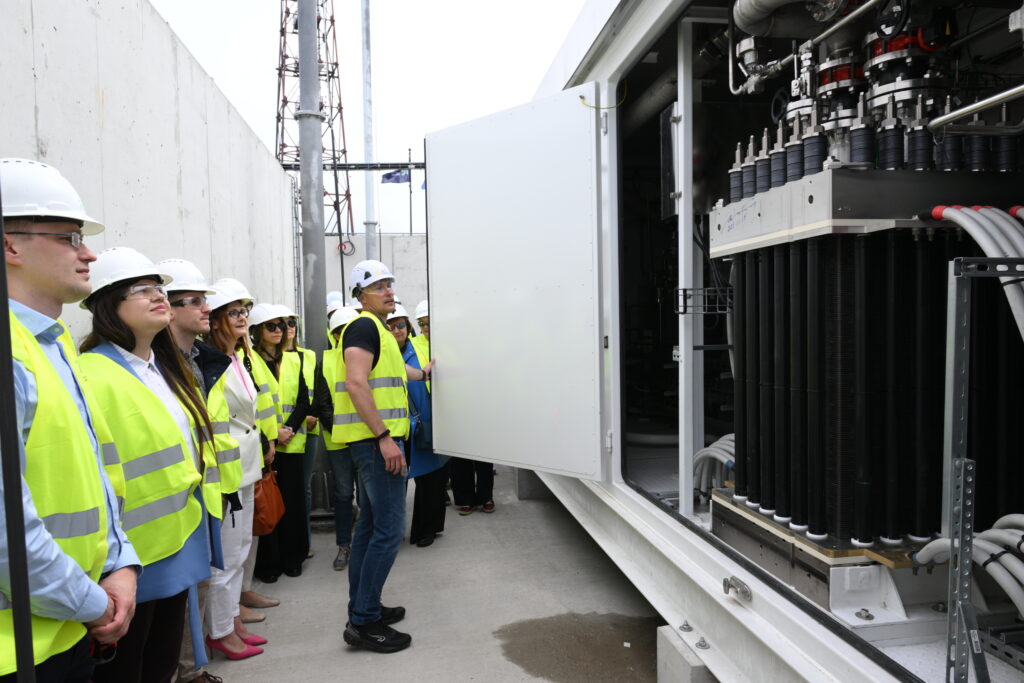
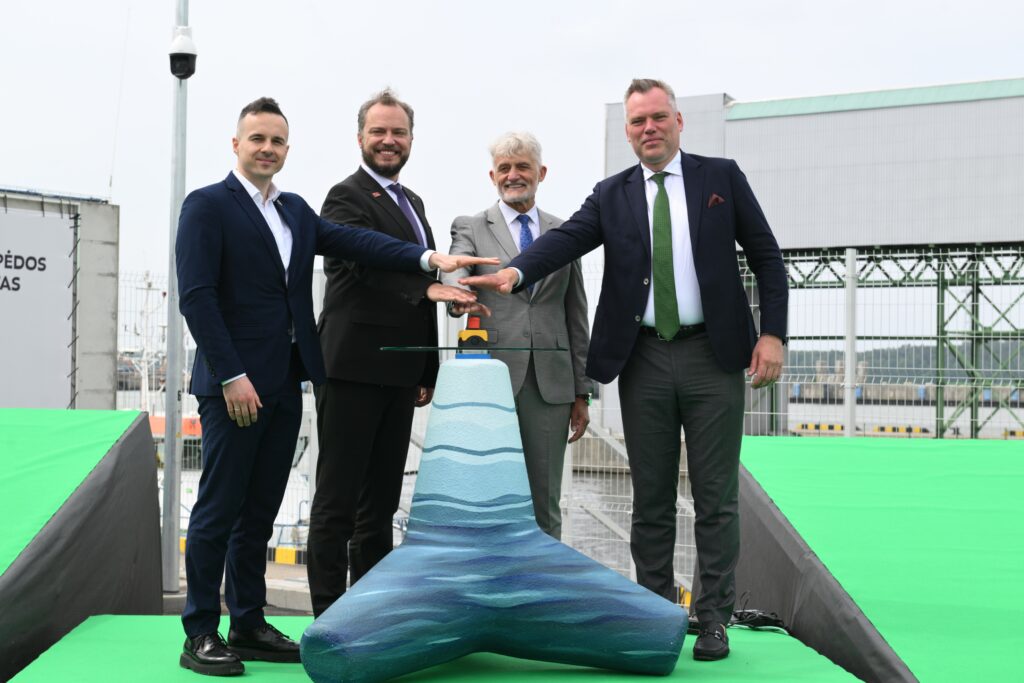
Klaipėda will launch Lithuania’s first public hydrogen refuelling station in 2026, open to business and residents. Hydrogen will be conveniently available for refuelling ships, cars, trucks and buses.
TECHNICAL PARAMETERS
The project is being implemented under the Economy Recovery and Resilience Plan “Next Generation Lithuania”, funded by the European Union’s NextGenerationEU. The total value of the hydrogen production and refuelling stations project is expected to be around €12 million, with EU funding of around €5,7 million.
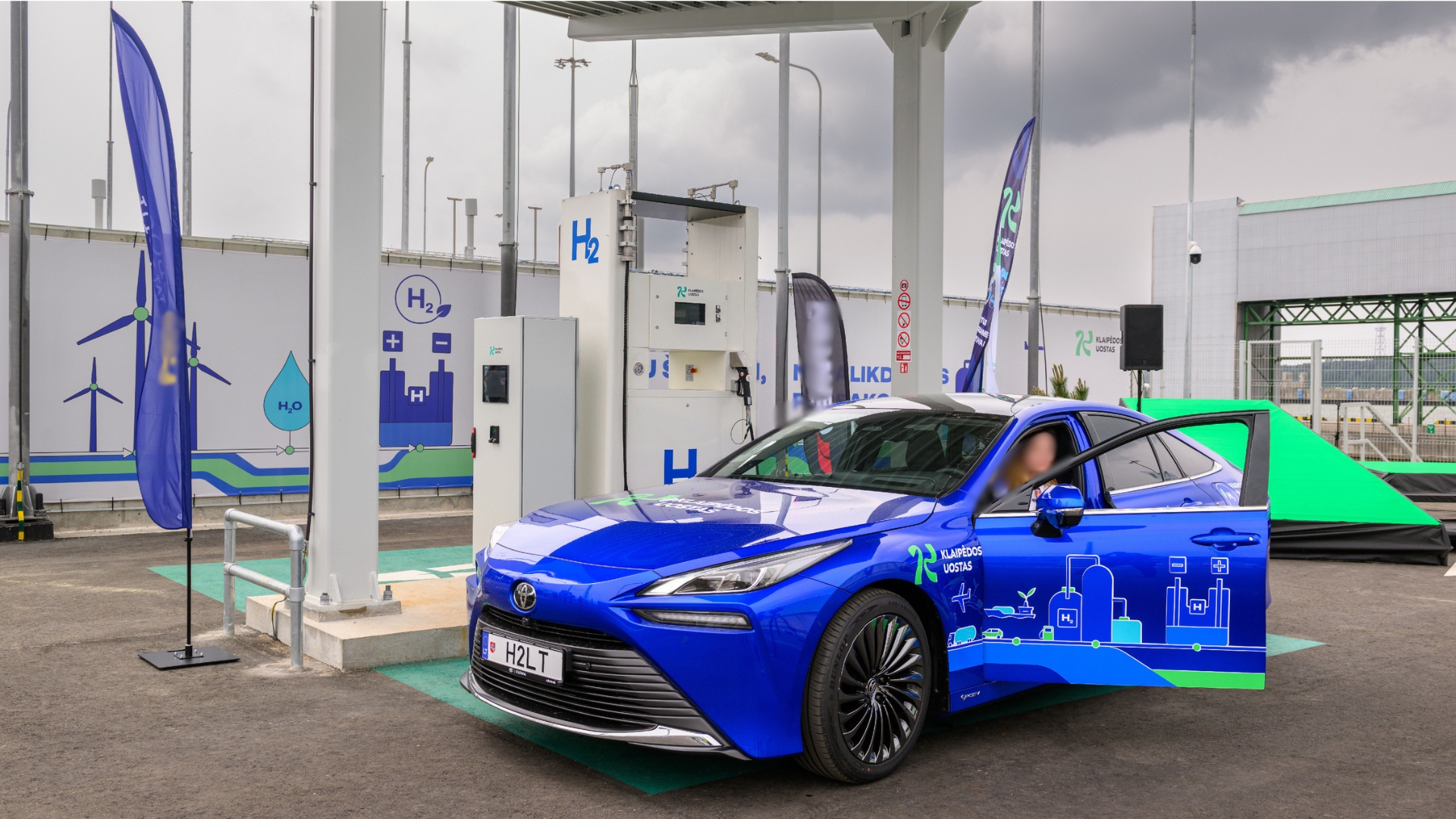
HYDROGEN REFUELLING STATIONS
Stations: 1 station for land transport and 1 for water transport.
Hydrogen gas pressure: 350 bar for heavy-duty and water transport, 700 bar for vehicles.
Refuelling time: approx. 20 min. for a bus, approx. 5 min. for a passenger car.
Refuelling station location: Nemuno St. 40, Klaipėda.
Working hours (Monday–Friday): 8:00 a.m. – 5:00 p.m.
Payment method: Bank card.
LOCATION
PROGRESS OF THE PROJECT
2023-2026
Januray 2023
Partial EU funding received

December 2023
Environmental impact assessment
May 2025
Construction permit
June 2025
The contract for the site is signed
Contractor – UAB “Gevalda”
2025 Q3
Manufacturing and testing of equipment
2026 Q3
Start of hydrogen production
FUNDING
The project is being implemented under the Economic Recovery and Resilience Plan “Next Generation Lithuania”, funded by the European Union’s NextGenerationEU recovery and resilience facility.
The total estimated cost of the hydrogen production and refueling station project is approximately €12 million, with around €5,7 million financed by EU funds.
Two contracts have been signed for EU funding:
you ASK – we ANSWER
Answers to the most common questions related to hydrogen production.
Hydrogen (H2) is a colourless, odourless gas. It is the most abundant chemical element and accounts for as much as 75% of the mass of the universe. Hydrogen is the most common element in water, minerals and acids, and forms various chemical compounds with other elements.
Hydrogen can be used as an alternative fuel in a wide range of industries and for home heating. It is important in chemical production and recycling. In the future, hydrogen will be produced more and more, in the transport and metal industries, in synthetic fuels, fertilisers, and it will make a significant contribution to reducing CO2 emissions and increasing energy independence.
Both the science in this field and the technology used to produce hydrogen are very advanced today. Hydrogen-powered vehicles are already on the road, and it is being tested as a source of heating for homes and a variety of industrial machinery.
Green hydrogen is produced using the most innovative technologies and systems. Thus, any leak, which is very unlikely, would be immediately detected and all systems would be shut down.
Hydrogen was discovered in 1766 by the English scientist Henry Cavendish. In 1888, the first hydrogen was produced by using an electrolyser to pass an electric current through water, splitting water molecules into oxygen and water.
Between 1960 and 1970, due to the increased demand for electricity and the availability of cheap natural gas, hydrogen production from fossil fuels, mostly natural gas, was introduced. This produces grey and blue hydrogen, but the hydrogen produced in this way contributes to global warming.
Producing hydrogen from renewable energy sources such as wind or solar can significantly reduce CO2 emissions and air pollution. Such hydrogen is considered as green. It is produced by electrolysis of water using electricity from renewable electricity sources. It is a clean way of producing hydrogen, with extremely low carbon dioxide (CO2) emissions as compared to other hydrogen production methods.
In the Port of Klaipėda, green hydrogen will be produced by electrolysis using a polymer electrolyte membrane (PEM) electrolyser. The hydrogen production plant will be installed in a standard 40-foot marine container. The hydrogen production facility in the Port of Klaipėda has a planned electricity demand of 3 MW.
Around 500 kilograms of hydrogen per day are planned to be produced in the Port of Klaipėda.
The Environmental Impact Assessment report estimates that around 22-23 litres of water are needed to produce one kilogram of hydrogen. Producing 500 kilograms of hydrogen per day would require approximately 11 m3 of water. With the plant operating at full capacity and producing around 127 tonnes of hydrogen per year, the water requirement would be around 4200 m3. This includes water for hydrogen production, water demineralisation and plant cooling. If we compare this water consumption with a standard car wash, the green hydrogen production in the port will use about 10 times less water than a car wash.
Water supplied by SC Klaipėdos vanduo will be used to produce hydrogen, as well as water for cooling the equipment.
During the environmental impact assessment two potential sites in the Port of Klaipėda for green hydrogen production and refuelling stations – the former Klaipėda Port Vessel Traffic Service site (Nemuno g. 8A, Klaipėda) and the fleet base of the Port Authority (Nemuno g. 40, Klaipėda) – were analysed.
The State Service for Protected Territories under the Ministry of the Environment and the Klaipėda Department of the National Public Health Centre under the Ministry of Health, which have examined the Environmental Impact Assessment Report and have issued conclusions on the planned activities, have issued positive conclusions on both alternatives, the Klaipėda City Municipal Administration has given a more favourable opinion on the first alternative, while the Klaipėda Territorial Division of the Department of Cultural Heritage under the Ministry of Culture, and the Fire and Rescue Department under the Ministry of Interior have issued a favourable conclusion on the second alternative. The Environmental Protection Agency, having evaluated the conclusions of all these companies, has decided that the site at 40 Nemuno Street is the more suitable location for the activity. The site is to be used for the construction of a hydrogen production facility and a refuelling system for vehicles. The green hydrogen production is planned at a distance of 150 metres or more from the nearest residential buildings. The conclusion of the Environmental Protection Agency is that this distance is entirely safe.
When selecting a site for the installation of green hydrogen production facilities and refuelling points in the port, all aspects were taken into account: the land owned by the Port Authority and currently unleased, convenient access to the water for refuelling hydrogen-powered vessels, and a convenient location for the city’s public transport system, as well as for the arrival of private individuals to refuel their vehicles with hydrogen.
The hydrogen plant will be installed in a standard 40-foot sea container. Two hydrogen filling stations will be installed adjacent to each other in accordance with the technical design.
The Environmental Protection Agency’s Environmental Impact Assessment concluded that the planned hydrogen production facility in the port does not qualify as a hazardous installation due to the small amount of raw materials/products to be stored at any one time. The planned hydrogen production facility in the port of Klaipėda will not store more than 100 tonnes of hydrogen at any one time, will not handle hazardous or non-hazardous waste, and will not involve the use of biological materials of groups 3 or 4.
In accordance with the provisions of the Inventory of Hazardous Substances and Mixtures, their Qualifying Quantities and the Criteria for Classification of Substances and Mixtures as Hazardous, hydrogen has been set at qualifying quantities of 5 tonnes and 50 tonnes, with the lower and upper tier requirements being applicable.
Around 500 kilograms of hydrogen per day is planned to be produced in the Port of Klaipėda.
Hydrogen produced at the Port of Klaipėda will primarily be used for port needs. A ship is being constructed for collecting waste from vessels departing from and arriving at the port, and it will be powered by green hydrogen produced in the port. The remaining hydrogen will be utilized to fuel other ships, railways, and road transport vehicles. Hydrogen will also be available for public transportation and private cars. An agreement has been signed with one of the cargo-handling companies operating in the Port of Klaipėda, which intends to use hydrogen for its locomotive. Some companies have shown interest, seeing its potential and planning to incorporate hydrogen into their vehicle fleets in the future.
Hydrogen production and refuelling is scheduled to start in 2026.
The methanol and green hydrogen plant to be built in Darbėnai Municipality of Kretinga District or in Naujoji Akmenė, is planned to be located on a 15-hectare site, covering an area of about 5 hectares. It is planned to produce 19.25 thousand tonnes of hydrogen and 100 thousand tonnes of e-methanol per year.
Only hydrogen will be produced in the Port of Klaipėda. It is planned to produce about 127 tonnes of hydrogen per year, which is 150 times less than the production planned in Kretinga District or Akmenė.
The hydrogen production equipment in the Port of Klaipėda will be installed in a standard 40-foot marine container on a 0.06-0.08 ha site.
The green hydrogen production and refuelling station projects in the Port of Klaipėda will be partly financed by the European Union Investment Programme 2021-2027 and the Economic Recovery and Resilience Plan “Next Generation Lithuania”.
The total value of the hydrogen production and refuelling station projects is expected to be around EUR 12 million, with EU funding of around EUR 5,7 million.
- A contract was signed on 27 June 2023 with the Central Project Management Agency for €4.8 million of EU funding. The total value of the project, excluding VAT, is almost €7 million. This will cover the installation of an electrolyser with the necessary equipment for hydrogen production.
- A contract was signed on 23 November 2023 with the Central Project Management Agency for EU funds of €1.44 million. The total value of the installation of the filling stations will amount to €3.6 million. This will cover site preparation works and the installation of two publicly accessible hydrogen filling stations.
The increasingly stringent environmental requirements of international organisations and national authorities, the increasingly promoted transition to climate and nature neutrality and other global trends oblige the Port of Klaipėda to take into account the state of the environment and continuously strive to improve it in the organisation of its future activities, in the development of its operations and planning of the projects of the port.
The scientists of Klaipėda University, who assessed the environmental emissions from the activities, transport and shipping of the Port of Klaipėda and p recommendations, also stressed that a shift to hydrogen and other alternative fuels would bring the port closer to zero emissions in the future.
Hydrogen is set to become an integral part of an integrated energy system in the EU by 2030, and Lithuania pursues to be ready for the transformation of the natural gas system by 2030, adapting the infrastructure to transport renewable energy. The aim is to ensure that Lithuania’s gas pipelines carry not only natural gas and biomethane, but also green hydrogen.
Today, the issue of how to safely produce, store and handle hydrogen has been resolved. The Port of Klaipėda will not be unique in producing hydrogen in an industrial area close to residential areas. For example, our Latvian neighbours have a hydrogen plant just a hundred metres from the population, while one of the hydrogen plants and a vocational training centre in Germany is only a street away.
According to the document “Risk-based safe distances for hydrogen refuelling stations” (Risico- en effectafstanden waterstoftankstations), prepared by the National Institute for Public Health and the Environment in the Kingdom of the Netherlands, a safe distance of 35 m is suggested for hydrogen filling stations where 1,000 kg of hydrogen is produced per day and the hydrogen gas is supplied to the station by a pipeline or on-site production.
In the United Kingdom, a project is being developed to introduce hydrogen into residential homes for heating. Domestic boilers are being replaced by hydrogen technology. Hydrogen will be supplied to an entire housing estate.
And in Japan, hydrogen refuelling stations are located right next to residential skyscrapers.
Around 200 hydrogen refuelling stations are already in operation in Europe and over 60 more are under construction.
which one. which do we choose?
PROPERTIES OF HYDROGEN
GLOBAL EXAMPLES


